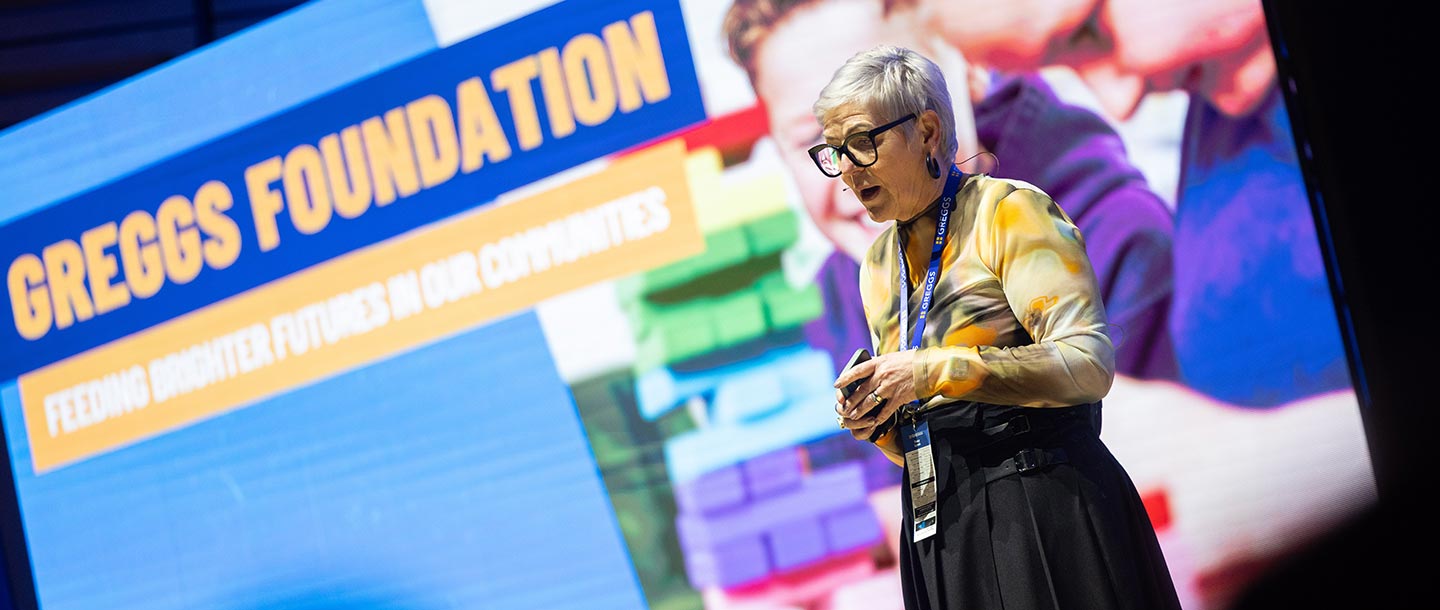
The Greggs Foundation is a grant-giving organisation aiming to improve the health and wellbeing of people living in the communities where Greggs operates. It works to strengthen communities by expanding opportunities, increasing support networks and reducing the immediate impact of poverty through responsive, forward-thinking grant programmes that meet the real needs of people across the UK.
In 2027, the charity will celebrate its 40th anniversary. We sat down with its leader Tracy Lynch, a ‘Greggs person through and through’, to discuss the Foundation’s history, how it’s evolving to respond to recent government policy, and what they’ve got planned for the future…
Could we start with a bit about your own background, your work history and how you started at the Greggs Foundation?
I’m privileged to say that I’m a Greggs person through and through. I originally trained as a pâtissier but over the years I ended up working more front of house, I think mostly because I like being around people.
I’ve been with Greggs for over 30 years. For the first 20 years of that, I was part of the retail and commercial side of the business. And then in 2012, I was lucky enough to get a secondment with Business in the Community, a charity promoting responsible business. At that time, they ran a programme called ‘Business Connectors’, where they took people out of their company, dropped them into an area of need and asked them to try to create connections and partnerships between the private and voluntary sectors.
I’d always been heavily involved in the charity side of things at Greggs but more as an enthusiastic fundraiser! It wasn’t until I had that 12 months on secondment that I realised I had this social conscience that was just itching to do more. A couple of years later, an opportunity to manage the Greggs Foundation came up and naturally I went for it.
I’ve been leading the Foundation for over 11 years now, and it’s been the most perfect role for me as I still have the structure of a corporate business but the freedom to be socially conscious. The opportunity to meet and support fantastic schools and community organisations is incredibly fulfilling. I’m not here to drive commercial decisions but I get to prioritise impactful work that makes a difference in a range of communities.
Leading the Foundation for over 10 years is an amazing achievement. Could you comment on that?
It’s a role that I’m incredibly proud to hold because I think we’ve really grown in the last 10 years, largely in response to the kind of societal issues that have come to light during that time.
When you think about it, there’s been so many changes over the past decade. We’ve had COVID and a global financial crash and then constant political uncertainty. There’s been a lot, but through all of it, we’ve been able to rise to the challenge and direct support where we felt we could make an impact.
In those 10 years, we’ve moved from a charity that has increased its giving from £1.5 million annually to last year, distributing £5.5 million. And we’ve been able to do that steadily without rushing at anything. We’ve been steadily making changes and growing our reach and, thankfully, have been fortunate to be able to offer more support.
Could you tell us a bit about the Foundation – how it came into being and a bit of its history up to today?
It’s been going for as long as Greggs has, for over 80 years or so, but originally it was philanthropic money from the Greggs family. They were well known for their pie and pea suppers and generally doing good stuff in the communities where they traded.
But the charity itself will be 40 next year and the Foundation has really grown in line with the Greggs business. For instance, when Greggs became a Plc, we were gifted shares, and those shares have become an investment portfolio which gives us a regular income each year.
When I first joined the Foundation, Ian Gregg said to me that the reason he had started the charity was because historically Greggs traded in some of the poorest communities and on some of the poorest streets, and we had a greater responsibility to those communities because they were either our staff or our customers. That’s still something at the core of what we do as a charitable foundation 40 years on.
You’ve touched on the donations from Greggs, could you expand on that and on your other income streams?
Over the years, we have managed to diversify our income.
About 60% of our income comes in through Greggs, from a 1% pre-tax profit donation every year. But we also receive a proportion of the profits from their Outlet shops (selling unsold food at a lower price), a donation from some of their product lines, and from their carrier bag income.
Then other funding comes from the support we receive from around 150 different businesses and individuals that have become interested in contributing to our work in the community, especially the schools programme – Feeding Brighter Futures.
We also do traditional fundraising through events and Greggs colleagues who find all sorts of great ways to raise funds for the Foundation.
And then we have that investment portfolio I mentioned earlier. So, we’ve got a healthy diverse set of income streams that gives us flexibility but also the ability to make longer-term strategic funding decisions.
And there are 3 main grant-giving programmes, is that right?
Yes, we have our Community Action Fund which is core funding of £20,000 per year for a minimum of 3 years to community organisations, right across the UK, addressing the needs of their local community.
And then we have our schools programme, which was traditionally our Breakfast Club programme, that has been running for over 25 years. That’s now evolving and transitioning into a slightly different programme, since the government announced they would provide all primary school children with a free breakfast, and I’ll talk more about this later.
And then both of those networks, both the community organisations and the schools, can apply on behalf of individuals that they work with within their network for emergency relief grants. These are designed to help individuals and families going through a crisis, to be able to help with things like white goods, beds or bedding, utility vouchers or even shopping vouchers.
You mentioned how the Foundation is reacting to changes in government policy with the evolution of the Breakfast Club, could you expand further on this?
Labour announced in their manifesto that they would provide all primary school children in England with a free breakfast.
It took some time for them to draw it up, but we were involved in discussions with the Department for Education policy team around how they intended to deliver it. They’ve gone with a policy of providing schools with funding, for food and staffing costs, and then the schools manage the process from there.
From our perspective, we are delighted that they have acknowledged it was needed. The Foundation have supported Breakfast Clubs for over 25 years, and we know that if children don’t have a breakfast, they will go hungry, they won’t concentrate at school and sadly won’t fulfil their potential. It’s been well studied and we knew that our programme worked.
But it has been difficult for us to manage that transition at times. Schools that haven’t joined the government programme still access breakfast club funding through us because we wouldn’t want to leave any children without their breakfast provision. We don’t know how long we’ll be doing this for at present so it’s a case of wait and see as the government programme expands its reach to more schools.
And I suppose it impacts how the public view it? How can you keep people on board with continuing to fundraise for Breakfast Clubs when they might think: ‘Oh, the government take care of that now’?
Yes, exactly. It has taken some time to get the messaging right so that our funders know how their donations are making a difference. We know the value of what we are supporting schools to deliver but ensuring that is communicated correctly has been difficult at times.
Our programme is now called Feeding Brighter Futures. And that will cover breakfast clubs, after school clubs, school enrichment programmes, and more. We’ve already seen the impact of that wider funding offer.
On that note, can you talk a bit about more about Feeding Brighter Futures?
We talk about Feeding Brighter Futures now as funding for ‘programmes and places’. Schools can use their grants to set up a whole new programme, such as start an orchestra, introduce a new sport, or even launch Lego clubs. Or the money could be used to make sure children whose families couldn’t afford a place at an existing club can get a free place using our grant.
We are really trying to break down those barriers to wider enrichment opportunities at school – cost should never be a barrier to opportunity.
One of the things we learnt from 25 years of working with schools is that children who aren’t as academic often end up missing out because so much of school life is about doing well in tests. But it means that some children might not have that moment to shine and they leave and move on to secondary school never knowing what it is they’re good at or have a passion for. But most of these things come with a cost, don’t they? We tend to completely forget that not all children have the financial means to access additional activities or enrichment, or even go on a school trip. We had one school that used our funding just to ensure their gymnastics team had leotards to compete in at local competitions so the children didn’t immediately feel that difference between them and the other schools competing. These small things, erasing those differences in opportunity, matter so much to children.
We’ve been surprised at how many schools have used the funding for travelling because lots of great cultural and historical attractions will offer the pupils free places, but the school then can’t afford the travel to take them. We’re very comfortable with that. We’re really trying not to be over prescriptive in what the school uses the grant for. We want them to make sure there are opportunities for children out of the standard curriculum, and where they can, give children the chance to experience something that perhaps they just might miss out on.
We’ve already had some great feedback. A school in Birmingham where the children had wanted to learn a new sport, started a badminton club, and it’s been a real success. They took their first £1000 grant from us and engaged with Badminton UK, who then really helped them in setting up their own weekly club which has gone down a storm with the pupils. They’ve since gone on to provide the kids with opportunities to go to tournaments in the UK, access equipment and have more professional coaching.
Like I say, that’s just great because it’s something that they wouldn’t have had the chance to do otherwise. And they’re using the badminton kit for the wider community now as well.
Our funding isn’t huge, it is £1000 per term, so £3000 a year. We may adjust that as we learn more about how the schools make use of the funding and the benefits the children get from it. We are always happy to evolve our offer if the need is there and we feel we can grow our impact.
The results from the first Greggs Pledge, a sustainability initiative launched in 2021 outlining ten key commitments to be achieved by the end of 2025, were recently released, and the next iteration is now up and running. Does the Foundation sit underneath the Pledge or to the side of it, how does that work and what is that going to look like for you going forward?
We are to the side of it I would say. It’s a Greggs pledge, it’s not ours. But it’s important to us too. As an independent charity the Pledge gives us something to work on together and it ensures we have joint objectives to meet.
In the previous 5 years, we were working with Greggs to reach 1000 Breakfast Clubs. At the point we reached the 1000, there was a change in government and Labour’s announcement to support breakfast clubs. It was quite timely, we’d reached that point where we’d done the programme for 25 years, the government was taking over, it felt right that we explore new directions.
We want to keep the network of schools we’ve spent 25 years developing but we are evolving this programme, so in the new iteration of the pledge, it was difficult to involve the schools.
Our focus in the next 5-year pledge has shifted towards the Community Action Fund and how many more community organisations we can offer support to. It works well with Greggs because we receive a proportion of the profits from the Outlet shops and that helps us to fund the Community Action Fund. Greggs prioritises food waste and the importance of reducing this by redistributing unsold food through the Outlet shops. And then we step in because we take that income and put it back into those communities.
I know we’ve talked about a bit about the future already, but do you have anything immediately on the horizon? Is it 40 years for the Foundation next year?
Over the last couple of years, we’ve been thinking about what we do because we’re very aware that we do a lot of work at the crisis end. A lot of our grant giving goes to support people already in a crisis situation.
With that in mind, we have now started to fund some strategic grants to organisations that do that effective and important work at that preventative end. One such relationship is with the Rank Foundation in Sunderland, helping them with a place-based programme. This will be something that we would want to develop over the next couple of years.
And then as you say, we’re 40 next year, and we really want to think about how we mark that.
Firstly, we have decided that we’re going to put some additional grants out over the next 12 months. We’re going to start this year and will be putting an additional £100,000 programme out so our schools can apply to do something exceptional that they wouldn’t have been able to afford to do before.
For the community organisations it will be a grant to support bringing communities together because one of the things we’re very conscious of at the moment is that society is becoming very divided. We may not be able to help directly but we do know some brilliant organisations that, with a little bit of extra money, will make something beneficial happen.
In addition, we’re going to fund a leadership programme for our community organisations. Many are small charities and they may never have either had the resource or the time to consider a leadership course that would develop themselves, and the future of their organisation.
And, yes, there’ll be a party at the end of all that! Our events manager will be desperate to start trying to organise what that will look like. But it’s important that we celebrate a milestone like 40 years.
And finally, do you have any highlights from your time at the Foundation that you’d like to speak of?
There’s been quite a few, because as we discussed earlier, in the last 10 years, there have been some big changes.
When COVID came, like lots of businesses, grant giving organisations were shutting down. We knew there was a need for our help more than ever. At the time, the DCMS (Department for Culture, Media and Sport) were offering some funding. We’d never applied to government funding before, but we did, and it was a match fund process – we asked for a million, and we asked our trustees for a million out of our investments, and we were successful!
As you can imagine, we were busier than ever trying to get that funding out to make sure organisations right across the country were able to keep supporting their communities in what was an incredibly stressful and difficult time for so many people.
That was a pivotal moment because we felt we then couldn’t let that level of funding slip. We realised we could work at that level, so how could we continue long-term?
We spent some time really developing our programmes to make sure it could happen. The relief programme, up until that point, had been about a £300,000 a year programme. During those 12 months of COVID, we disbursed around £1.5 million, and the programme has continued at around £1 million since then. We never went backwards. We learned how to manage it to ensure we remained effective for those communities.
And our relationship with Greggs has worked so well over the years. They’re proud to have us and we’re incredibly proud to work alongside them. The relationship is as strong now as it was 40 years ago.
But if I’m honest, it’s the team that I have around me that I’m most proud of. Over the last few years, we have put in two new systems to help us automate some of the processes and are currently on our third and final stage. That’s been a lot of change for everyone alongside our growing funding programmes. I really think the team that I’ve got is just brilliant. They’re all highly adaptable and between them they’ve developed a huge skillset. And I know I will look back and feel privileged to have worked with such a wonderful team who all care about those communities we serve.
This interview is taken from our latest Charity Bulletin.