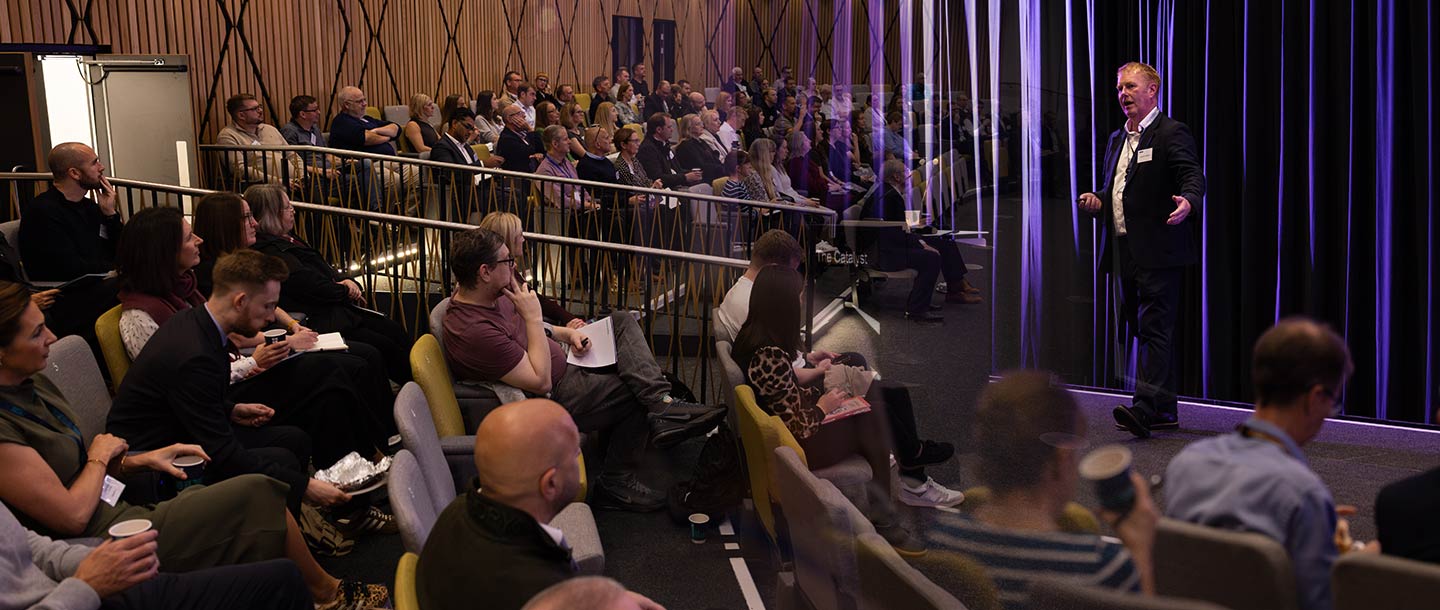
At UNW’s recent Business Taxes Update seminar, Tax Partner Alastair Wilson gazed into his crystal ball and shared his predictions ahead of Chancellor John Healey delivering the first Budget under Prime Minister Andy Burnham on Wednesday 28 October.
Speaking to around 100 clients and professional contacts from across the North East, Alastair explored Whitehall rumours of a ‘do no harm’ Budget, citing in particular the impact of former Chancellor Rachel Reeves’ decision to increase employers’ National Insurance contributions, announced in October 2024 and implemented in April 2025, and the subsequent decline in job creation.
Using an economic axiom attributed to Churchill as a basis – ‘For a nation to try to tax itself into prosperity is like a man standing in a bucket and trying to lift himself up by the handle’ – he went on to illustrate what he considered to be ‘bad tax policy’, showing the audience a graph from the Office for National Statistics depicting the downward trend in the number of people employed by UK businesses since October 2024.
Alastair said: “If you tax job creation, you get less job creation. That is what did happen in October 2024, and what has happened since. John Healey and Andy Burnham are very alive to this being a bad outcome in terms of what policy can do, and I’d be amazed if you don’t see them starting to try and do things to turn that trend around.”
Budget predictions
“So, what do I think is absolutely nailed on?” mused Alastair. “I would quite happily purchase a hat, and eat it forkful by forkful, if the Government doesn’t keep the reduction in fuel duty, which is supposed to be reversed in March 2027.” And why such certainty? “Because they’ve done it for years, and it’s actually now a running joke in tax circles.”
Considering potential revenue-raising measures that would affect relatively small sections of the electorate, Alastair suggested that the banking and oil sectors could be in the Chancellor’s sights (“I think I would already be resigned to the fact that there will be something coming…”), along with Partners of LLPs: “A year ago, the Government looked at it and said, ‘Should we bring that in line with employees in terms of National Insurance costs?’. I think they were rolling the pitch a year ago, and if you were to say, ‘What could a Chancellor bring in as a revenue-raising measure that not a lot of the typical Labour heartland would be likely to complain about when it came to elections?’, I think Partners of LLPs would be the one that they could look at.”
Turning to Capital Gains Tax, Alastair said: “A couple of years ago, the CGT rate on residential property gains was reduced from 28% to 24% – a little tweak that not a lot of people could complain about would be to just put it back up to 28% again.”
Making what he described as a “bolder, braver forecast”, Alastair said: “I don’t think the alignment of a Capital Gains Tax to Income Tax will happen because of the huge amount of work required to put back in place what is effectively an equivalent of Indexation or a Taper Relief, and I think there are easier things for them to tackle.”
Predicting a “relatively quiet Budget”, with the Government seeking to minimise disruption (“They’ve already said there isn’t going to be a Wealth Tax or an Exit Tax.”), Alastair ended on a more optimistic note about what might lie in store on 28 October: “On the hopeful side, they do no harm and they think about what they could do to rectify job creation going in reverse, and in particular, the effect that this is having on the younger job-seeking people in our society for whom support is now clearly needed.”
Watch the full seminar: A recording of UNW’s Business Taxes Update is available below.
Budget analysis: We’ll publish our summary of the key announcements on 29 October, the day after the Chancellor’s statement.